
In this article
Start with the title tag, then work down through headings, content, internal links, and schema. That order matches how Google reads a page, and it's the backbone of every on page SEO checklist I run before hitting publish. Skip the metadata and you'll bury great content. Skip the schema and you'll miss free rich-result real estate. This walkthrough covers each element you need to audit, with the gotchas that trip up even seasoned marketers.
Why does an on page SEO checklist matter before you publish?
An on page SEO checklist catches the small errors that quietly cap a page's ranking ceiling before it ever competes. Running through one before publishing means you fix issues while editing is cheap, instead of months later when the page has already stalled in search results.
Think about the math. A page that ranks in position 8 instead of position 3 might lose two-thirds of its potential clicks. Backlinko's analysis of Google click-through data has long shown the top three results soak up the lion's share of clicks. A weak title or missing heading structure is often the difference.
I've audited pages that had brilliant writing buried under a vague H1 and a duplicate meta description copied from a sister page. The content deserved page one. The signals didn't. Fixing those took twenty minutes and moved the page four spots inside a month.
Treat the checklist as a pre-flight ritual. Pilots don't skip it because they've flown a thousand times. Neither should you.
Auditing your title tag and meta description
Your title tag is the single highest-leverage on-page element. It tells Google what the page is about and convinces a human to click. Get it wrong and nothing else recovers the loss.
Keep titles under roughly 60 characters so they don't truncate in desktop results. Lead with the primary keyword when it reads naturally. A title like "On Page SEO Checklist: 12 Elements to Audit" beats a clever-but-vague headline every time for an informational query.
Here's what nobody tells you: Google rewrites your title in the SERP more often than you'd think — sometimes over half the time, according to studies from Zyppy and others. The fix isn't to fight it. Write a title that already matches search intent and your H1, and rewrites drop sharply.
For meta descriptions, treat them as ad copy, not a summary. They don't directly influence rankings, but a description that promises a clear payoff lifts click-through rate. Aim for 120 to 155 characters, include the keyword once, and end with a reason to click. One product page I worked on gained 18% more clicks just by rewriting its descriptions to lead with the benefit instead of the brand name.
Headings, content structure, and keyword placement
One H1 per page. That's the rule I never break. Use it to state the page's core topic, and make it distinct from the title tag rather than an exact copy.
Below it, your H2s and H3s should form a logical outline a reader could skim and still understand. Search engines use that hierarchy to grasp how subtopics relate. Phrase a couple of headings as real questions people ask — it earns you a shot at featured snippets and matches how voice search works.
For keyword placement, put your primary term in the first 100 words, naturally. Sprinkle related terms and synonyms through the body. Don't count occurrences obsessively. If you're writing thoroughly about the topic, density takes care of itself, usually landing around 1%.
Solid keyword research feeds this whole step. You can't optimize structure for terms you haven't mapped. Before drafting, group your target keyword with its semantic neighbours so each section answers a distinct sub-question.
One common mistake: stuffing every heading with the exact keyword. It reads like a robot wrote it, and Google's helpful-content systems notice. Write for the person reading, then nudge the phrasing toward your terms.
Optimizing URLs, images, and internal links
Short, descriptive URLs win. Strip out dates, parameters, and stop words. A slug like /on-page-seo-checklist tells both users and crawlers exactly what's coming. Avoid changing established URLs without a 301 redirect — broken links bleed authority fast.
Images need three things checked: compressed file size, descriptive alt text, and a sensible filename. Alt text should describe the image for screen readers and give context to search engines, not cram in keywords. "on-page-seo-audit-dashboard.jpg" beats "IMG_4821.jpg" every time.
Internal links are the lever most marketers underuse. Each link passes relevance and authority while guiding readers deeper. Link from this page to closely related guides using descriptive anchor text — not "click here." When you publish a new piece, go back and add links to it from older, relevant pages.
If your site is JavaScript-heavy, internal linking gets trickier; rendered links may not be crawled the way you expect. Our notes on single page application SEO cover that pitfall in detail.
A quick gut check I use: can a crawler reach every important page in three clicks from the homepage? If not, your internal linking needs work.
How do you audit page speed and Core Web Vitals?
Run the page through Google PageSpeed Insights and check the three Core Web Vitals: Largest Contentful Paint, Interaction to Next Paint, and Cumulative Layout Shift. Aim for LCP under 2.5 seconds, INP under 200 milliseconds, and CLS under 0.1. Field data matters more than lab scores.
Speed is partly a technical concern, but on-page choices drive a lot of it. Oversized hero images are the usual culprit. Compress them, serve modern formats like WebP, and set explicit width and height attributes to stop layout shift.
Lazy-load below-the-fold images and defer non-critical scripts. I've seen a single uncompressed background video drag LCP past five seconds — slow enough that bounce rate climbed and rankings slid.
Test on a throttled mobile connection, not your office fibre. Most of your audience is on a phone, and Google indexes mobile-first. A page that feels instant on your laptop can crawl on a mid-range Android.
For the deeper infrastructure side — server response, render-blocking resources, crawl budget — lean on our technical SEO guide, which pairs naturally with this on-page work. The two overlap, and treating them as one workflow saves time.
Schema markup and structured data
Schema markup is structured data you add to a page so search engines understand its content precisely — and it can unlock rich results that make your listing stand out. For an article, use Article schema. For a how-to, FAQPage or HowTo. For products, Product with price and availability.
Add it in JSON-LD format, Google's preferred method, in the page head. Then validate it. The Rich Results Test and Schema.org validator catch syntax errors that silently disable your markup. I always run both before publishing because one missing bracket kills the whole block.
Don't mark up content that isn't visible to users. Google's guidelines are explicit about this, and violating it can trigger a manual penalty. The schema must reflect what's actually on the page.
FAQ schema deserves a mention. Match it to a genuine FAQ section, like the one closing this article, and you give Google clean question-answer pairs to surface. It won't always show as a rich result, but the structured signal still helps comprehension.
A practical sequence: write the content, confirm it renders, then layer schema on top and validate. Doing it in that order stops you from describing content that changed during editing.
Choosing the right tools for an on-page audit
You don't need a dozen subscriptions. You need three or four that cover crawling, on-page analysis, and validation. The trick is using them in a repeatable order so nothing slips.
Screaming Frog crawls your site and flags missing titles, duplicate descriptions, broken links, and orphan pages in one pass. For free, Google Search Console shows real query data, indexing status, and Core Web Vitals from actual visitors — irreplaceable for understanding how a page truly performs.
Add a platform like Ahrefs or Semrush for content scoring and competitor comparison. Their on-page graders tell you which terms top-ranking pages cover that yours doesn't. That gap analysis often reveals an entire subtopic worth a new H2.
If you're weighing options, our breakdown of the best SEO tools for 2026 and the dedicated SEO audit tools roundup will narrow the field faster than trial-and-error.
My honest take: start free. Search Console plus a manual checklist gets a small site 80% of the way. Pay for the heavy tooling once volume justifies it. Buying enterprise software before you've mastered the basics is money wasted.
A repeatable pre-publish checklist you can reuse
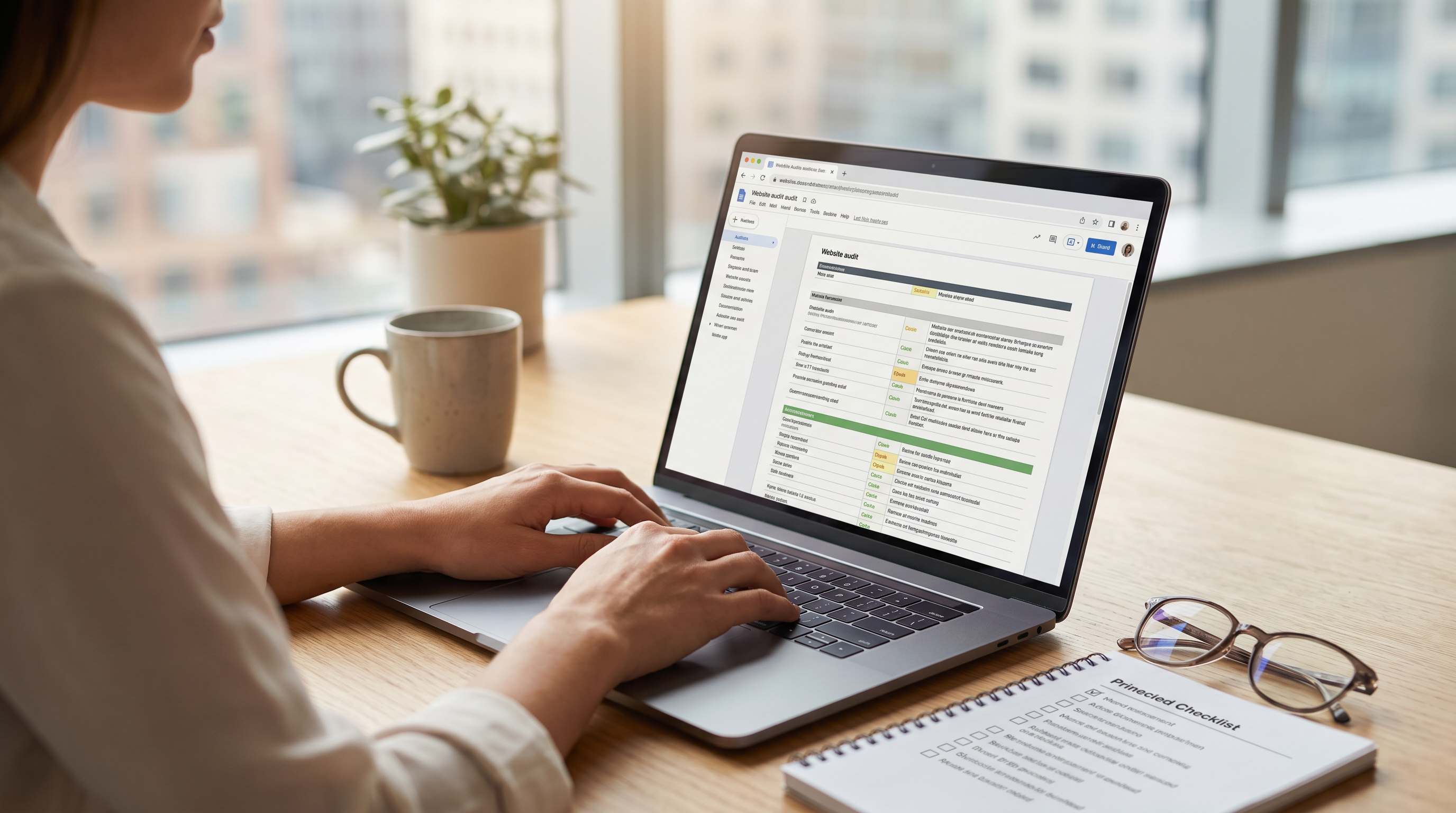
Turn everything above into a short list you run every single time. Consistency beats memory. Here's the sequence I follow before any page goes live or gets a refresh.
- Title tag: under 60 characters, keyword near the front, compelling to click.
- Meta description: 120–155 characters, one keyword, clear benefit.
- H1: single, descriptive, distinct from the title.
- Headings: logical H2/H3 outline, a question or two for snippets.
- Keyword: in the first 100 words, used naturally throughout.
- URL: short, readable, no stray parameters.
- Images: compressed, alt text written, sensible filenames.
- Internal links: 2–4 relevant links with descriptive anchors.
- Speed: Core Web Vitals checked on mobile.
- Schema: correct type added and validated.
Print it. Pin it. Whatever keeps it in front of you. The point of a checklist is that it removes judgment from the routine parts so your attention goes to the content itself.
Revisit older pages with the same list quarterly. Search intent shifts, competitors update, and a page that ranked well a year ago may now be missing a section everyone else covers.
Frequently Asked Questions
How often should I run an on page SEO audit?
Audit every page before publishing, then review your priority pages quarterly. High-traffic and revenue-driving pages deserve more frequent checks because small ranking shifts cost the most there. Set a recurring crawl with Screaming Frog or Search Console alerts so site-wide issues surface automatically between your scheduled manual reviews.
Does on-page SEO still matter with AI search results?
Yes, arguably more. AI-generated answers and overviews pull from well-structured, clearly written pages with strong headings and schema. Those are exactly the on-page signals this checklist covers. Clean structure, accurate metadata, and validated structured data make your content easier for any system — traditional or AI — to extract and cite confidently.
What's the most common on-page mistake marketers make?
Duplicate or templated title tags and meta descriptions across many pages. It happens when CMS templates auto-generate them and nobody overrides the defaults. Each page needs a unique, intent-matched title. Run a quick crawl, sort by title and description, and you'll usually find dozens of duplicates worth fixing in an afternoon.
Should I optimize for one keyword or several per page?
Target one primary keyword per page plus a cluster of closely related terms and questions. Trying to rank a single page for unrelated keywords dilutes its focus and confuses search engines. Map each page to one clear topic during keyword research, then cover the surrounding subtopics thoroughly within that page's sections.